The Need for War
Power, Fear and the Domino Effect of War
Is war a necessity or a fulfilment of one’s greed? One could argue it’s both. War is an action coined by one man’s greed for power and wealth, whilst simultaneously being a reaction from another out of fear and pride. It emerges from humanity’s ugliest evolutionary traits: greed for resources, fear of the “other,” and the lust for dominance.
For centuries, the world has been infested by wars declared by powerful men to gain or regain power. From the very first war recorded in history in 2700 BCE, in Mesopotamia between Sumer and Elam, to the current ongoing wars both in the West and the East, war has evolved into a complex phenomenon. But one could say war is a meticulously engineered tool now evolving to an industry. Arms dealers, politicians, and corporations treat bloodshed as a business model, trading lives for power while branding it “patriotism.” It has become synonymous with a game of dominoes; where one action leads to another, and everyone and everything with the falls. However, the last to touch the ground claims the title ‘conqueror’.
As we examine the cyclical nature of conflict, it’s crucial to ponder whether war is an unavoidable aspect of human existence or a reflection of our deepest desires for control and superiority. Ultimately, the impact of war resonates through history, shaping societies and human relationships in profound ways.
The action of war constitutes a plague to the nation; however, it may be perceived as a satisfactory sight to the leader. While leaders may derive a sense of satisfaction from displays of power, the true cost is ultimately borne by the future of the nation, as they are eradicated at the front lines under the guise of nationalism and regaining the control they never had. Families are left with negative energy that they could never attain unless they were to lie on their headstones. Burdened and confronted with sudden grief but prided with a salute and social grace.
War rarely serves the interests of the nation, but is for the betterment of the overly comforted leader, who remains insulated from the ensuing chaos. The divide is unrecognisable by many until they find themselves in the perceived safety of their beds, confronted with the disheartening reality that their predicament may be worse than it was prior. Their only reward for enduring such trauma is often a questionably preserved medal and the enduring mental scars of conflict. The emotional toll of war lingers long after the cessation of hostilities, profoundly affecting countless lives and leaving an indelible mark on society.
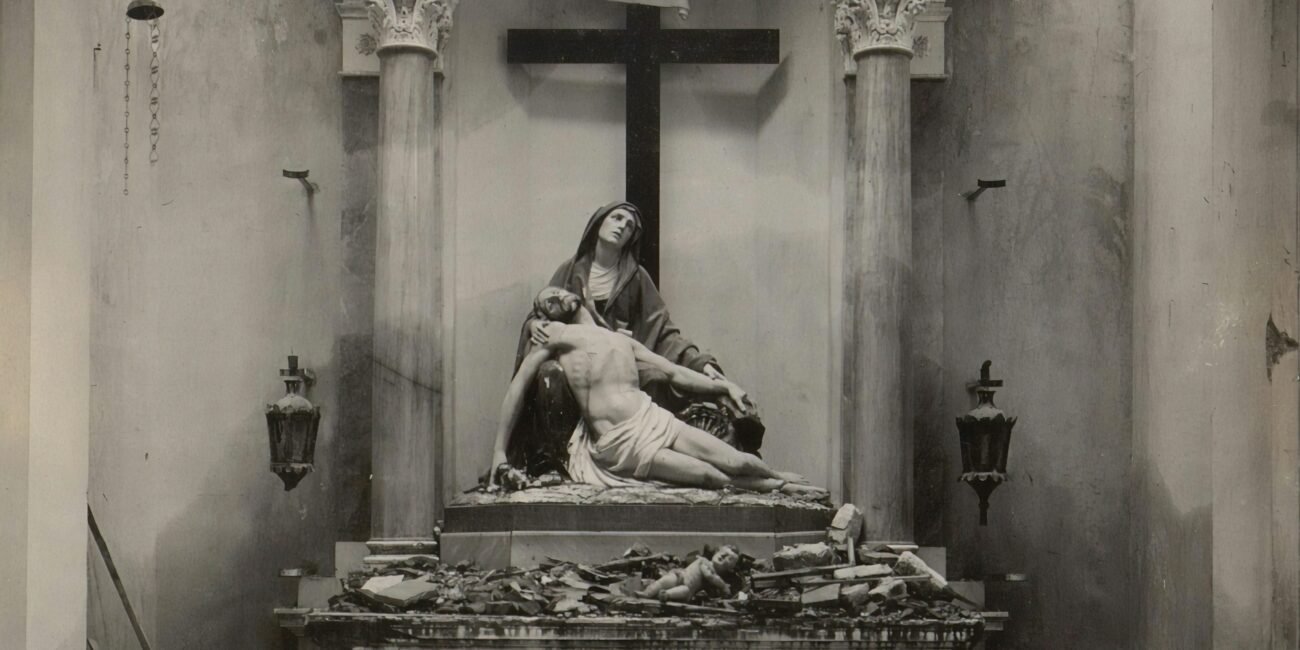
Photo by Austrian National Library on Unsplash
War’s cruelest irony is its ability to unify even as it destroys. The unified response by societies, rallying around flags while leaders manipulate conflict as a bargaining chip. Yet the notion from a possibly “biased” angle is of a nation and its leaders becoming a singular entity. This response is characterised by the trepidation of traversing a path from which they may never return, accompanied by a collective contemplation of how their current circumstances have evolved. If war is truly humanity’s evolutionary crucible – born of resource scarcity, clashing ideologies, and power struggles – then why after millennia does it still resemble predation masquerading as progress? The weapons grow smarter, but the calculus remains primitive: the strong feast, the weak become fertiliser, and history books call it ‘necessity.’
Maybe it is within this crucible of shared fear and uncertainty that the profound bonds of brotherhood among veterans are forged. Ultimately, the strength of this brotherhood serves as a testament to the resilience of the human spirit, showcasing how shared adversity can cultivate enduring relationships that offer solace and strength long after the battles have ceased.
This profound kinship is marred by a stark irony: society reveres veterans in rhetoric but abandons them in practice. They are called “heroes” at parades, yet they are left to navigate PTSD, addiction, and homelessness alone. They are respected, but not acknowledged – honoured in the abstract, yet erased in the tangible. This troubling disconnect does not apply to every veteran, but its prevalence is distressingly high and deeply concerning.
The community’s curated memory moulds the discourse surrounding ex-servicemen and the archetype of the “valiant soldier”. This archetype serves as a convenient framework for civilians, allowing them to view military personnel through a lens that romanticises their sacrifices without requiring deeper engagement or understanding.
Veterans are typically commemorated for their hardships, and recognised as illustrious heroes who have persevered through extreme adversities. However, this glorification comes with a paradox: they frequently encounter significant barriers to meaningful reintegration into civilian life. The very qualities that elevate them in public perception can render their struggles invisible. When these individuals return from the battlefield, they often find themselves confronting an unforgiving societal landscape that fails to acknowledge the complexities of their experiences.
Moreover, while veterans might be pitied for their trauma, this pity can quickly turn to discomfort when their pain becomes too pronounced or visible. Society’s collective tendency to avert its gaze leaves many veterans feeling isolated and misunderstood. The complexities of PTSD, physical injuries, and emotional scars often remain unspoken, swept under the rug of civility in favour of a sanitised image of heroism. As their suffering fades from the headlines and political discourses, many veterans find themselves in a stark reality; alone with their challenges, devoid of the support they desperately need.
Political leaders frequently invoke the imagery of veterans in their speeches, reducing their rich and nuanced experiences to mere statistics. This depersonalisation strips away the individuality of their lived realities, creating a chasm between what is presented to the public and what is felt by those who have served. The narratives surrounding veterans become a form of tokenisation, with their true stories drowned out by the roar of rhetoric.
Ultimately, this selective memory perpetuates a cycle of celebration devoid of accountability, leaving veterans stuck between the pedestal they are placed on and the profound isolation they often endure. Acknowledging their reality requires not only remembering their sacrifices but also actively engaging with their struggles. It calls for a commitment to understanding, support, and reintegration beyond the simplistic labels of heroism and victimhood. Only then can society honour the complete spectrum of their experiences.
The men and women who return from war are bound by more than shared trauma – they are tethered by the tearful prayers of mothers who once begged for their safety, and by the silent understanding that no civilian, no matter how well-intentioned, can truly grasp what they carry. They gain little but perseverance without peace, trading bullets for bureaucratic neglect, and their sacrifice is reduced to slogans and folded flags.
Amid this abandonment, the veteran’s bond becomes both sanctuary and indictment. Sanctuary to those who have stared into war’s abyss can recognise its shadow in another’s eyes. Their unspoken pact becomes the only armour against a world that praises their suffering but recoils from its consequences. The indictment reveals their solidarity, exposing the hypocrisy of a system that sends them to die for “freedom,” yet denies them the most basic desire: other than the elusive notion of freedom, a body, whole in the presence of their family.
A somewhat peaceful nation can only be recalled in memories, overshadowed and ridiculed with ashes and crumbled foundations. Most fought for a return to “normalcy,” only to find that home, too, is a battleground – one where they must fight for healthcare, dignity, and the right to grieve what what was lost. Behind every casualty statistic lies this truth: war does not end when the treaties are signed. It migrates into the marrow of those who survived, and into the hands of mothers still waiting, decades later, for a safety that never comes.
What, then, is the necessity of war? This inquiry yields a remarkably subjective response, shaped by individual perspectives and societal contexts. Ironically, it is often in times of conflict that a nation exhibits a profound sense of unity, manifesting on both extremes of the ideological spectrum.
War may catalyse collective action, compelling citizens to rally around a common cause, whether for defence or liberation. Moreover, in the realm of international relations, war can be wielded as a bargaining chip. Leaders may resort to conflict not solely for territorial gains but also to negotiate power dynamics, often leveraging the threat of war to achieve political objectives.
This phenomenon reveals the paradox of human nature; while war brings destruction, it also has the capacity to unify disparate factions within society. However, it is crucial to examine the motivations behind war. Are they rooted in the pursuit of power or in the strategic use of conflict as a tool for negotiation? Understanding these motivations allows for a deeper exploration of the ethical implications of war and its enduring impact on humanity.
